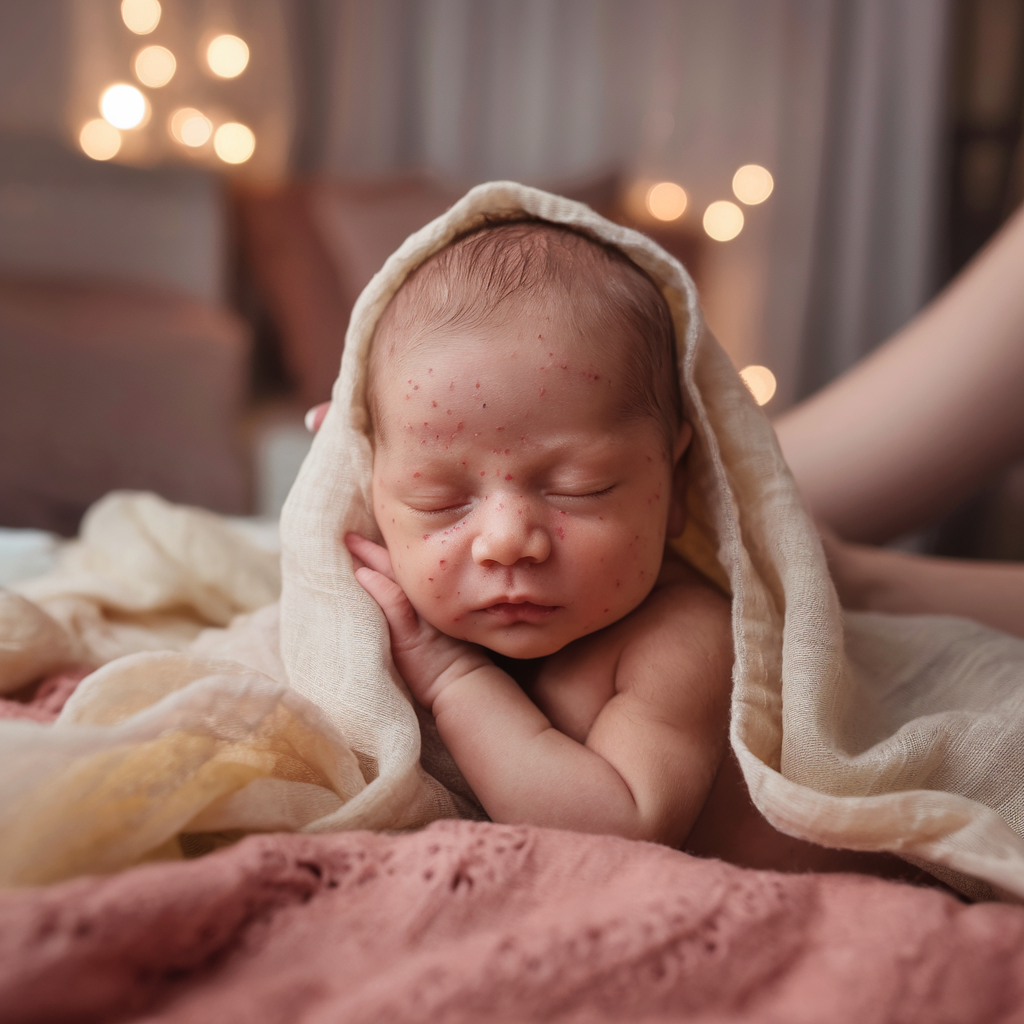
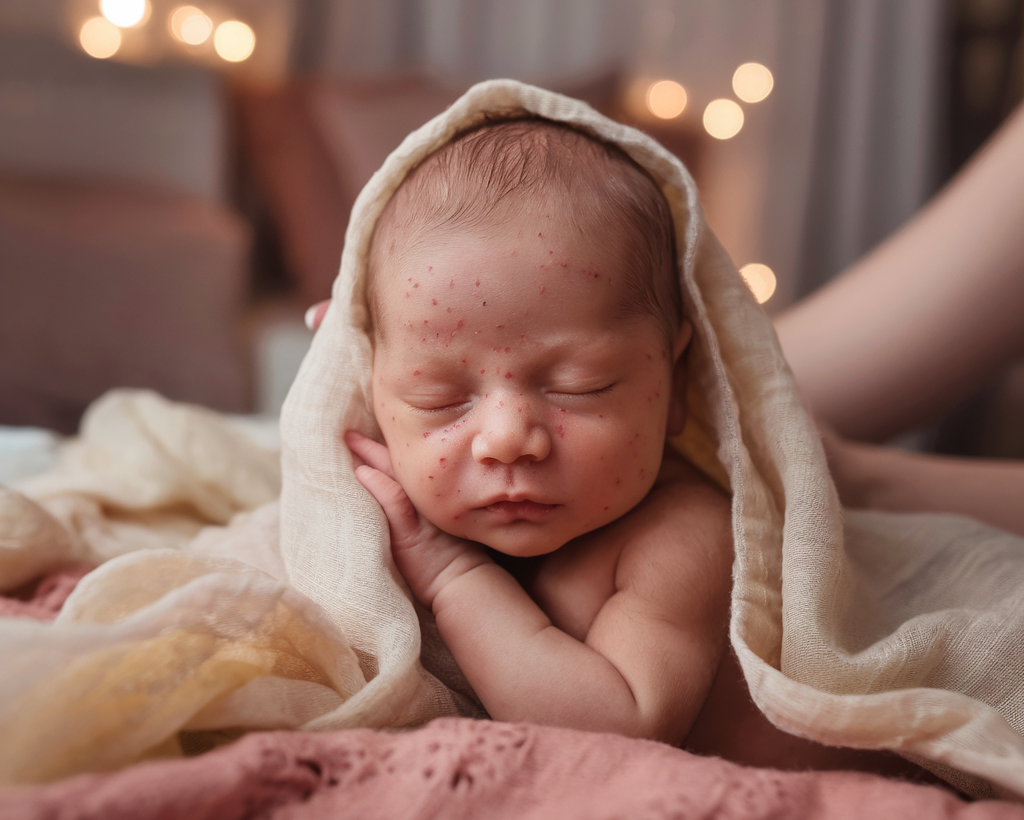
Quick answer: Baby acne appears as small red or white pimples on the cheeks, nose, and forehead, typically at 2–4 weeks of age. It’s caused by maternal hormones and resolves on its own in 2–3 months without treatment. It doesn’t indicate poor hygiene, diet problems, or anything requiring intervention.
What causes baby acne
Baby acne (neonatal acne) is caused by maternal androgens (male hormones) that crossed the placenta during pregnancy and are still circulating in the baby’s blood after birth. These androgens stimulate the sebaceous glands in the baby’s skin, producing excess sebum and causing the glands to become blocked — the same mechanism as adolescent acne, driven by the same hormone class, in miniature. The hormones gradually clear the baby’s system over weeks, and the acne resolves with them. It is not caused by breastmilk composition, the mother’s diet, using the wrong products on the baby’s skin, or inadequate cleaning.
How it looks
Classic baby acne: small red papules (pimples) and sometimes whiteheads (milia) on the cheeks, nose, chin, and forehead. It may appear worse after crying (increased blood flow to the face makes the redness more visible), after being held against warm clothing, or after bathing. It typically appears at 2–4 weeks of age, peaks at around 1 month, and usually resolves by 2–3 months. It can be mild (a few spots) or quite extensive (covering much of the face).
What it’s not: distinguishing from other rashes
Milia (tiny white dots, usually at birth, caused by blocked sweat glands) — very common, resolve on their own within weeks. Erythema toxicum (red blotchy rash with pale centres that comes and goes in the first week of life) — extremely common, harmless. Eczema (dry, itchy, rough skin that may weep or crust, persists, and appears in characteristic locations) — different distribution, different texture, starts later (usually 2–3 months), requires treatment. Infected spots (single spots that are significantly larger, redder, warm, and possibly weeping pus) — these need doctor assessment as they may be infected folliculitis. If in doubt about any rash, a doctor or pediatrician can examine and distinguish.
Management
Baby acne requires no treatment. Don’t squeeze, pick, or apply creams or lotions. Wash the face gently once daily with plain water and a soft cloth. Don’t apply adult acne treatments (benzoyl peroxide, retinoids, salicylic acid) — these are not safe on infant skin. Don’t apply baby oil or heavy moisturisers — these can clog pores further. The rash resolves when the maternal hormones have cleared the baby’s system, typically by 2–3 months.
Frequently Asked Questions
Will baby acne leave scars?
No — neonatal baby acne does not cause scarring. The pimples resolve completely without treatment as the hormones clear. Scarring from acne requires deeper inflammation than baby acne produces.
My 4-month-old now has a rough, red, itchy rash on the cheeks — is that still baby acne?
Probably not — baby acne typically resolves by 3 months. A rough, itchy, persistent rash appearing at or after 3 months is more likely to be infantile eczema. Eczema at this age often starts on the cheeks and scalp. See your doctor — emollient cream and, if needed, mild topical steroid are the appropriate treatment.
Is breastmilk good for baby acne?
The traditional practice of applying breast milk to baby skin has some antimicrobial properties that may benefit minor skin conditions. The evidence for baby acne specifically is anecdotal rather than from controlled trials. It won’t cause harm. That said, baby acne resolves without any treatment, so the comparative benefit of breast milk vs ‘do nothing’ is minimal.
Related Reading
- Baby acne vs eczema: how to tell the difference
- Eczema in babies: causes, triggers and treatment
- Rashes in babies: a visual guide to common skin conditions
Found this helpful? Sign up to the LylyMama newsletter — evidence-based answers to the questions every new parent actually has.