
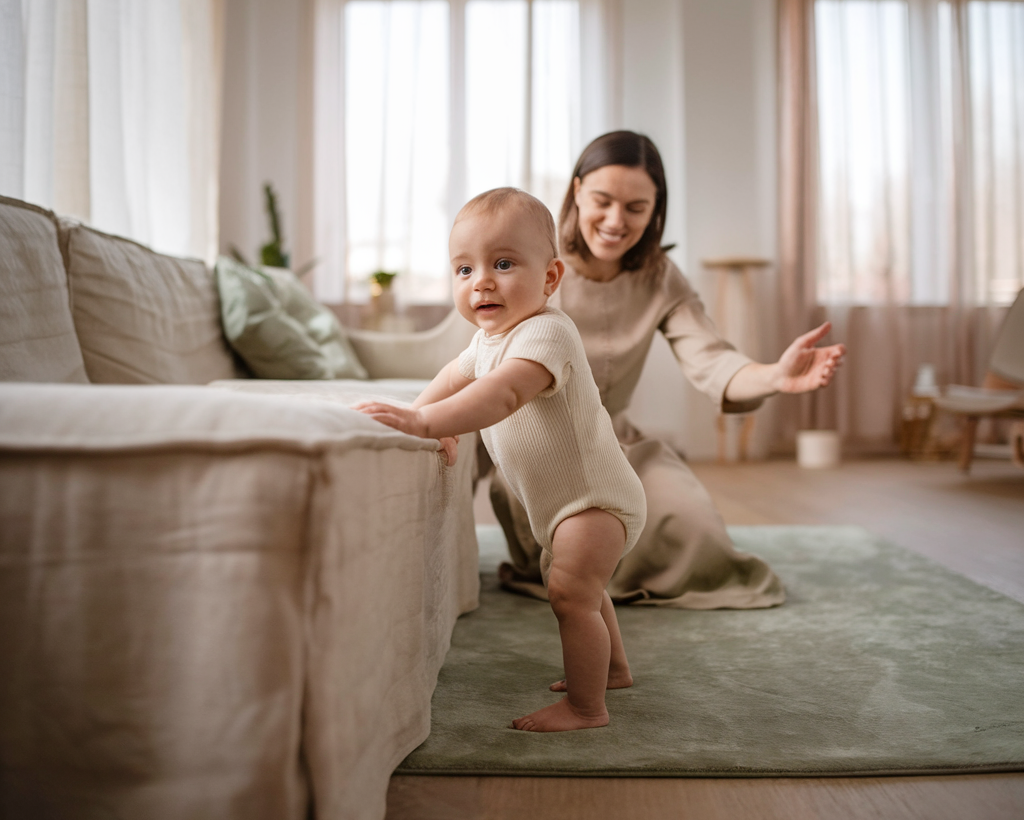
Quick answer: Ten months is walking’s waiting room — most babies at this age are cruising, some are taking their first independent steps, and all are focused on the upright world they’re about to join.
Ten months is walking’s waiting room — most babies at this age are cruising, some are taking their first independent steps, and all are focused on the upright world they’re about to join.
10 Months Milestones
At 10 months: cruising confidently along furniture, possibly standing briefly without support, advanced pincer grasp allowing pick-up of very small items, beginning to use objects functionally (holding a spoon toward mouth, pressing buttons), ‘dada’ and ‘mama’ used meaningfully, understanding 10–20 words, showing object permanence fully (actively searching for hidden objects), pointing expressively and responsively, and showing clear intentionality in communication.
Sleep at This Age
At 10 months, some babies are beginning to drop the second nap or transition to one longer midday nap — though the typical transition age is 12–18 months. Night sleep is often well-established for families who have sleep trained. Growth spurts and developmental leaps continue to cause temporary disruption.
Feeding
Diet increasingly overlaps with family meals. Most choking hazard foods (whole grapes, nuts, large chunks) are still avoided. Texture should now be roughly minced or chopped — not fully smooth. Self-feeding with hands is the main mode; spoon introduction is happening though messy. Offer a varied iron-rich diet.
Practical Tips This Month
- Create safe cruising courses — push a couch near a coffee table to create a connected path.
- Offer a push-toy walker (not a sit-in baby walker, which are not recommended) for balance practice.
- Increase the complexity of reading — simple storylines, ‘where is’ questions.
- Practice ‘in’ and ‘out’ with containers — develops spatial concepts and fine motor skills.
- The 10-month check-up varies by country — if there’s a scheduled visit, have your developmental questions ready.
Walking timeline and what affects it
The normal range for first independent steps is 9–15 months, with most babies walking by 12 months. Walking later in this range is not a developmental problem — it is variation within normal. Factors that affect timing include temperament (cautious babies often walk later than risk-taking ones), body build (higher weight-to-height ratio makes balance harder initially), how much floor time the baby has had (babies who spend significant time in seats and carriers often walk slightly later than those with extensive floor exploration), and whether crawling was established (some babies bottom-shuffle rather than crawl and walk slightly later). The developmental concern threshold for walking is 18 months — if a baby is not walking independently by 18 months, a GP assessment is appropriate regardless of other developmental milestones.
Frequently Asked Questions
When will my baby walk?
First independent steps occur typically between 9–15 months, with 12 months being the average. Walking requires the combination of balance, strength, coordination, and the confidence to let go of support — this last factor is often behavioral as much as physical. Some babies who can clearly walk cruise indefinitely because holding on feels safer. Normal walking range is up to 18 months; beyond 18 months without any walking warrants evaluation.
Should I use a baby walker?
Wheeled sit-in baby walkers are not recommended. They delay walking development (by reducing floor time and the need to develop balance), are associated with significant injury risk (particularly stair falls), and don’t improve motor milestones. They are banned in Canada. Push-along walking toys (that baby stands behind and pushes) are safe and useful for balance development.
My 10-month-old won’t eat vegetables — what should I do?
Food refusal and selective eating are normal at this age as autonomy and preferences develop. Strategies: continue offering rejected foods repeatedly without pressure (research shows 15+ exposures may be needed before acceptance), eat vegetables yourself visibly and enthusiastically, offer vegetables alongside preferred foods, involve baby in food preparation, and avoid making mealtimes a battle.
Disclosure: This post contains affiliate links. We may earn a small commission at no extra cost to you. We only recommend products we genuinely trust.
Related Reading
- 9 month old baby: first words coming – how to encourage speech
- Do babies need shoes before they walk?
- 11 month old baby: weaning from the breast or bottle
Found this helpful? Sign up to the LylyMama newsletter for evidence-based baby development guides delivered to your inbox every week.