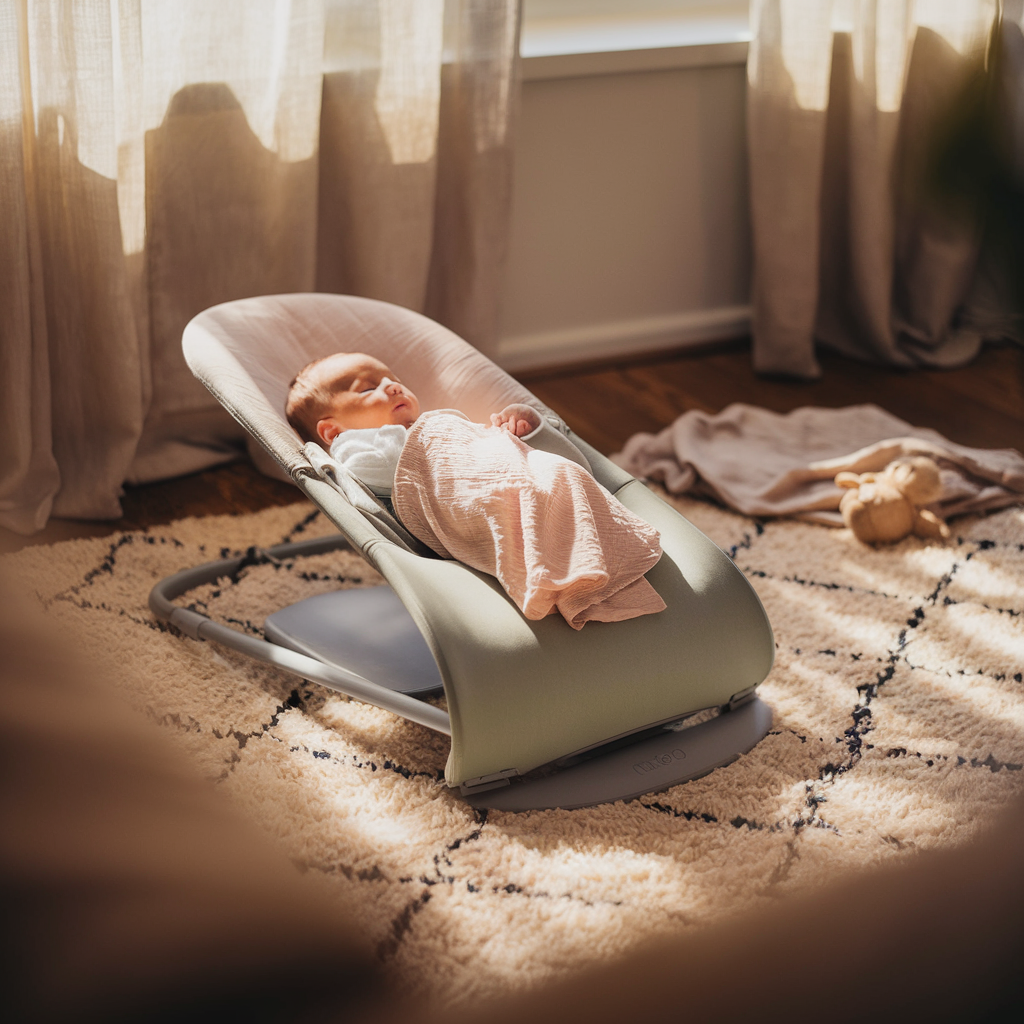
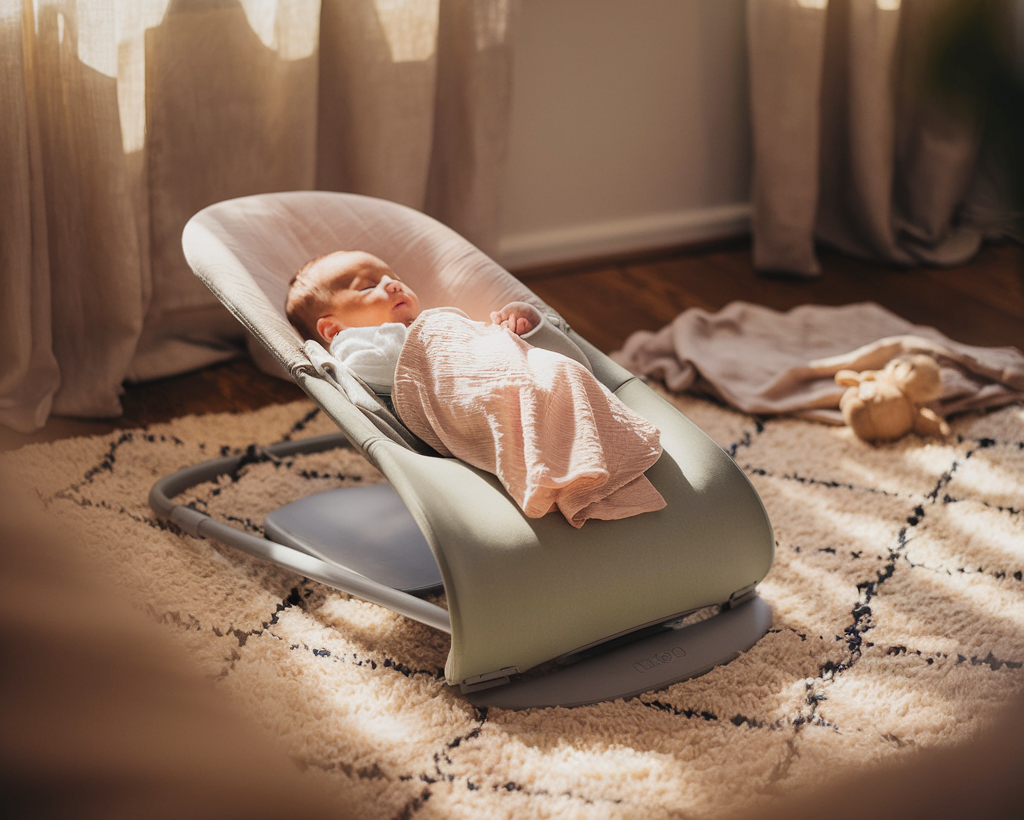
A baby bouncer provides a safe place to put your baby down that isn’t the floor, where motion or vibration may soothe them enough to give you 20 minutes to eat, shower, or exist. The gap between a good one and a poor one is significant.
Do baby bouncers actually work
Safety — use on the floor only, not raised surfaces. Never leave unattended on elevated surfaces. Angle — current guidance recommends under 30 degrees for unsupervised use; don’t use inclined sleepers for sleep. Motion type — bounce-on-demand vs automatic rocking vs vibration. Weight limit — most rate to 9kg or 6 months; some continue to 25kg.
Budget: BabyBjörn Bouncer Bliss — ~£130
The benchmark baby bouncer. The bounce is responsive to the baby’s own movement — micro-movements amplified into a gentle self-perpetuating bounce many babies find deeply soothing. No batteries required. Three recline positions. Fabric cover removes for washing. Maximum 13kg. One of the most consistently recommended bouncers by health visitors and lactation consultants.
Pros: Self-perpetuating bounce from baby’s movement, no batteries, washable, three reclines, 13kg limit
Cons: Expensive for a bouncer, not all babies respond to gentle bounce
Best for: Most newborns — our first-choice recommendation for the majority of families
Mid-range: Chicco Hoopla Baby Bouncer — ~£60
Provides manual bounce (parent-operated) and three recline positions at a significantly lower price than the BabyBjörn. The arch toys are engaging from about 3 months. Weighs only 2kg — genuinely portable between rooms. For families unsure whether their baby will tolerate a bouncer, the lower price point makes it sensible.
Pros: Lower price, lightweight, arch toys for engagement, decent recline
Cons: Parent must bounce rather than self-perpetuating, lower build quality
Best for: Budget-conscious families, or as a second bouncer for grandparents
Premium: 4moms MamaRoo 4 — ~£250
Five different motion types (car ride, kangaroo, tree swing, wave, rock-a-bye) with adjustable speed and built-in Bluetooth speaker. Some babies who reject standard bouncers accept the MamaRoo’s different patterns. App-controlled. Worth considering if a simpler bouncer hasn’t worked.
Pros: Five motion types, Bluetooth speaker, app-controlled, stylish design
Cons: Very expensive, not all babies prefer it, less portable
Best for: Families whose baby rejected simpler bouncers, or those wanting maximum motion variety
How to choose — and what to try first
Don’t over-invest before knowing whether your baby will use a bouncer — some babies simply prefer being held and won’t settle in any device. If budget is a constraint, start with a less expensive model. Only upgrade if your specific baby responds positively and you want more features. Key practical note: always use the bouncer on the floor, never on an elevated surface. Move a sleeping baby to a flat sleep surface — a bouncer is a supervised seat, not a safe sleep environment.
Frequently Asked Questions
Is it safe for babies to sleep in a bouncer?
Bouncers and rockers are not safe sleep surfaces — this is the position of the AAP, the Lullaby Trust, and Safe to Sleep. If your baby falls asleep in a bouncer, transfer them to a firm, flat sleep surface (cot, Moses basket, or bassinet) as soon as you notice. Inclined and reclined positions carry a risk of positional asphyxia because young babies lack the neck strength to reposition their airway if their chin drops to their chest. There is no safe supervised napping threshold in a bouncer.
At what age do babies stop needing a bouncer?
Most babies outgrow the soothing function by 4–6 months as they become more interested in sitting up.
My baby won’t settle in the bouncer — is something wrong with it?
No — some babies simply don’t respond to any bouncer regardless of brand or quality. Try: different recline positions; the bouncer placed on a slightly uneven surface for more natural motion; white noise nearby; trying just after a feed. Some babies accept a bouncer once they’ve been in one for a few weeks. If your baby consistently prefers being held, meeting that need directly is the appropriate response.
Related Reading
- Newborn sleep: how much is normal and why they wake so much
- Nursery essentials checklist: what you actually need vs nice-to-haves
Disclosure: This post contains affiliate links. If you buy through our links we may earn a small commission at no extra cost to you. We research products independently and are never paid to recommend specific items.
Found this helpful? Sign up to the LylyMama newsletter for honest, researched guides on everything you need in pregnancy and early parenthood.
The Bliss’s self-perpetuating bounce — amplifying the baby’s own micro-movements — is what distinguishes it from cheaper bouncers where the bounce requires parental input. Many babies will lie contentedly in the Bliss for extended periods because the motion responds to them. The fabric cover unclips and machine washes. Three recline positions include a more upright setting for older babies who want to observe.
At 2kg the Hoopla is among the lightest bouncers available — genuinely portable between rooms without disassembly. The arch toys engage babies from approximately 3 months. For families unsure whether their baby will accept a bouncer, the lower price makes the Hoopla a sensible test. The parent-operated bounce can be maintained with a foot while hands do other things.
The MamaRoo’s five motion types — car ride, kangaroo, tree swing, wave, rock-a-bye — each with adjustable speed and amplitude, cover a wider range of soothing stimuli than any standard bouncer. Some babies who reject simple bouncing accept the MamaRoo’s more varied patterns. The Bluetooth speaker and app control are useful features at their price point.