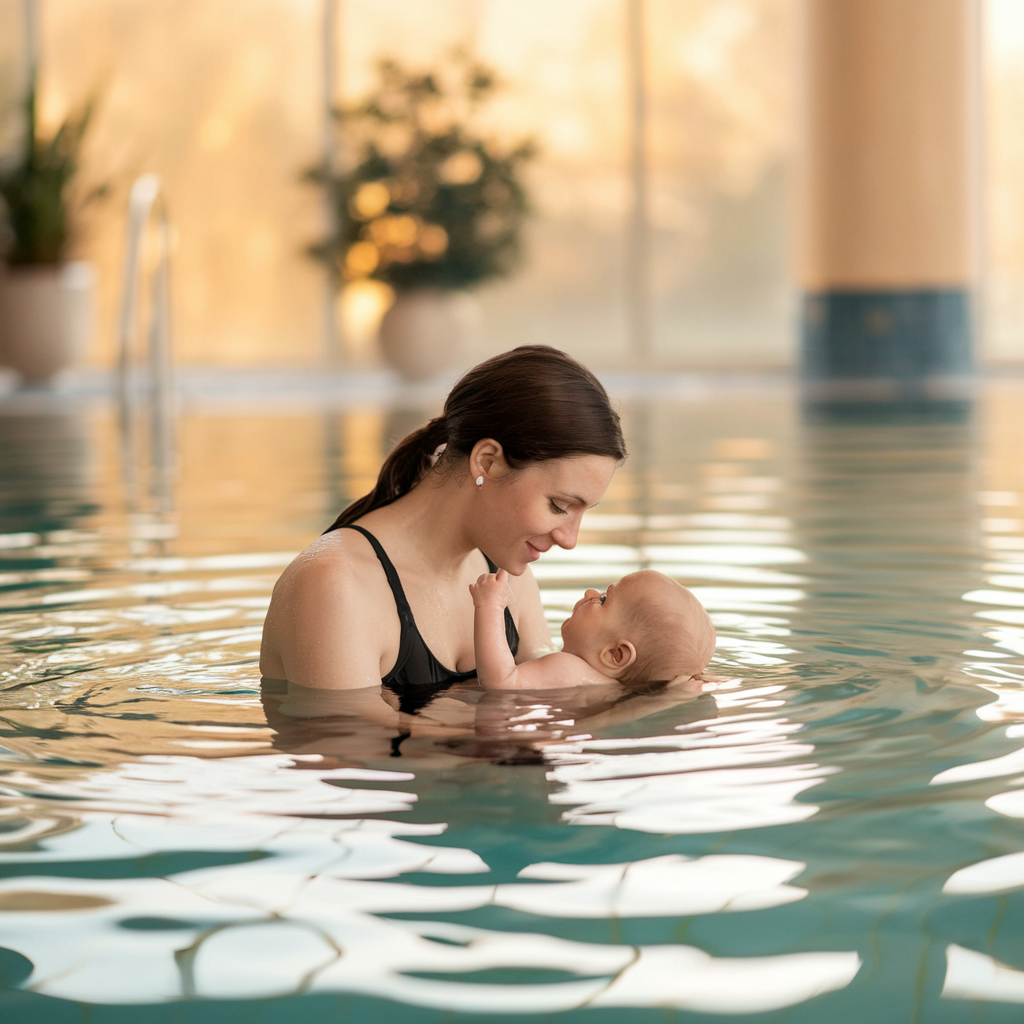
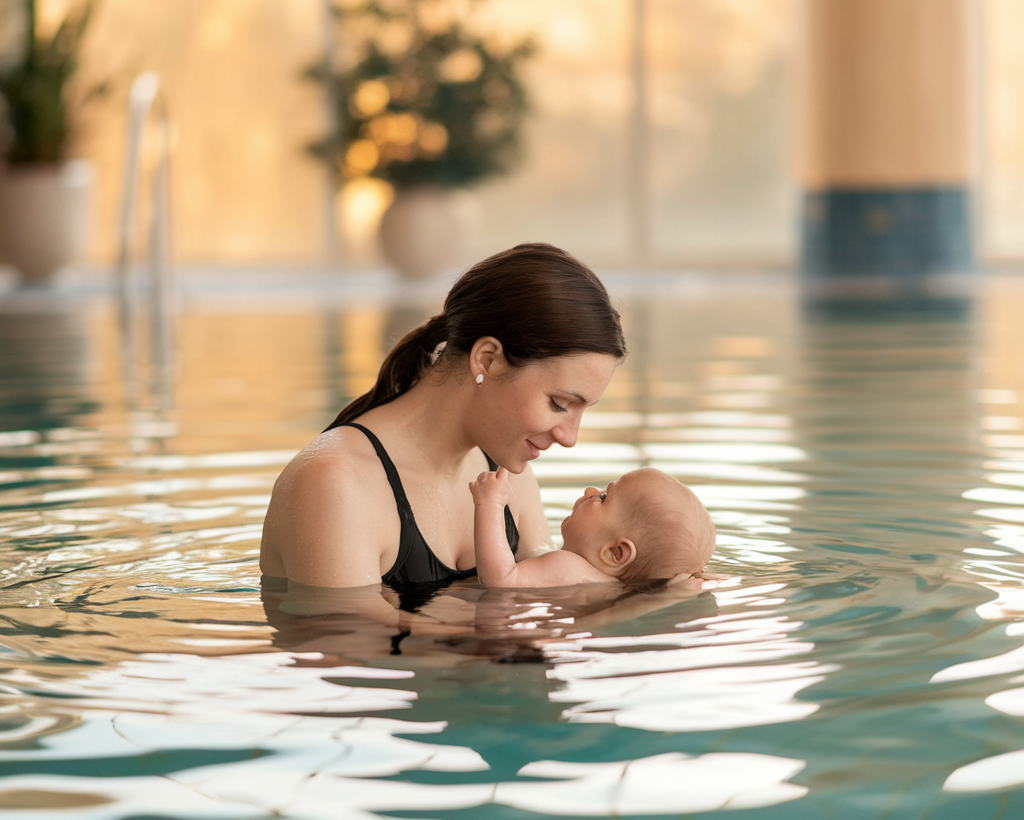
Quick answer: Babies can go in a pool from any age — there is no medical minimum age. Most public pools recommend waiting until babies have had their 8-week vaccinations. Private or baby-specific pools suitable from birth. The water must be warm enough (32°C minimum for young babies).
No medical minimum age
The idea that babies must wait until a specific age before swimming has no medical basis. Young babies have strong innate aquatic reflexes — the diving reflex (breath-holding on face submersion) and the swimming reflex (arm and leg movements in water) are present from birth and strongest in the first 6 months before they fade. What constrains early swimming is practical: water temperature requirements for young babies are higher than most public pools maintain, and immune system considerations matter for shared pool environments.
The 8-week vaccine guideline
The NHS and most public swimming guidelines recommend waiting until after the 8-week vaccinations before taking a baby to a public pool. This is a precaution related to immune system maturity, not a strict medical rule. The 8-week jabs protect against diphtheria, tetanus, whooping cough, polio, Hib, and meningococcal disease — pathogens present in shared water environments. Private pools with clean, properly treated water carry lower risk, and many instructors run ‘baby splash’ classes from birth specifically in controlled private pool environments.
Water temperature requirements
Water temperature is the main practical consideration for young babies. Babies under 3 months: minimum 32°C — most public pools are maintained at 29–30°C, which is too cold for prolonged immersion. Hypothermia risk is real: newborns and young babies cannot shiver effectively and lose body heat rapidly. Limit time in the water: under 3 months, 10–15 minutes maximum. 3–6 months: 20 minutes. Over 6 months: follow your baby’s cues — shivering, blue lips, or pale skin mean out of the water immediately.
Swim diapers
Regular diapers absorb water and become heavy, useless, and a pool contamination risk. Swim diapers (disposable or reusable) contain solids but allow water to flow through — they don’t hold liquid. This means a swim diaper alone won’t prevent urine from entering the pool, but it will contain faecal matter. Most public pools require a swim diaper for babies under approximately 3 years. Double-layer systems (a reusable neoprene cover over a disposable swim diaper) are the most reliable containment.
What to expect in the water
Most babies enjoy warm water immersion — it closely mimics the womb environment. Initial sessions may involve crying as the baby adjusts to the sensation. Face submersion (brief, controlled, from about 6 months with a specific cue) should not be rushed — wait until the baby is comfortable and confident in the water. Formal baby swimming classes teach water confidence progressively; the most important outcome of early swimming is positive association with water, not any specific technique.
Frequently Asked Questions
Will swimming cause ear infections?
Regular swimming doesn’t cause ear infections in babies without pre-existing conditions. Water entering the ear during a swim session typically drains naturally. If your baby has had recent ear infections or has grommets, check with your doctor before swimming.
Can I take my baby swimming if they have a cold?
A mild cold without fever is usually fine. Avoid swimming if: your baby has a fever, has had diarrhoea or vomiting in the previous 48 hours, or is visibly unwell. Public pools have rules against swimming with gastroenteritis specifically because of contamination risk.
Does swimming help babies sleep?
Many parents find that a morning or afternoon swim session produces notably better sleep in the afternoon or evening. The physical activity, water resistance, and sensory stimulation are collectively tiring. The effect is real but not guaranteed — very young babies sometimes find the stimulation overstimulating and become harder to settle.
Related Reading
- When can babies have water?
- 3 month old baby: sleep regression or just a growth spurt?
- Sensory play ideas for babies: age-by-age activities
Found this helpful? Sign up to the LylyMama newsletter — evidence-based answers to the questions every new parent actually has.