
Quick answer: Six months is a landmark — the beginning of solid foods, a significant developmental leap, and the halfway point of the first year.
Six months is a landmark — the beginning of solid foods, a significant developmental leap, and the halfway point of the first year. Your baby is increasingly mobile, vocal, and engaged with the world around them.
6 Months Milestones
At 6 months: sitting unsupported (briefly at first, with better balance developing through the month), passing objects between hands reliably, picking up objects with a raking grasp (fingers raking toward palm — the pincer grasp comes later), imitating sounds and facial expressions, beginning to understand cause-and-effect (if I drop this, it makes a sound), showing separation anxiety beginning to emerge (a sign of healthy attachment, not a problem), and babbling with consonant-vowel combinations (‘ba’, ‘da’, ‘ma’).)
Sleep at This Age
Many 6-month-olds have consolidated to 2 naps per day (morning and afternoon). Nighttime varies — some sleep 10–12 hours with 1–2 feeds; others wake more frequently. Sleep training is well-supported developmentally from this age. The 6-month growth spurt and developmental leap can temporarily disrupt previously good sleep.
Feeding
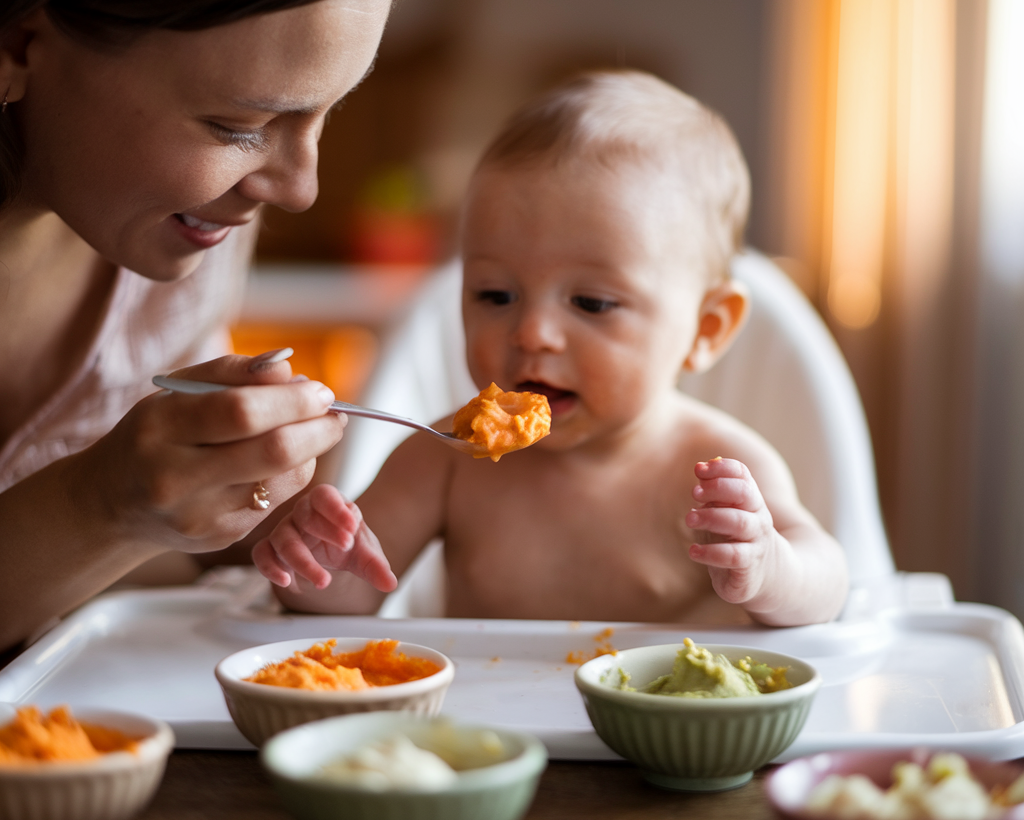
Starting solids is appropriate from 6 months when all readiness signs are present. Two approaches: traditional purées (smooth puréed vegetables, fruits, proteins) or baby-led weaning (soft, appropriately sized finger foods from the start). Both are safe and effective — a combination approach is also common. Key first foods: iron-rich foods are the priority (fortified cereal, puréed meat, lentils, beans) — breast milk is low in iron by 6 months and baby’s stored iron needs replenishing. Introduce allergens early (peanut, egg, tree nuts, fish) — current evidence supports early introduction reducing allergy risk.
Practical Tips This Month
- Introduce allergens one at a time, 3–5 days apart — peanut, egg, tree nuts, and fish are highest priority.
- Always sit baby upright for meals — never reclined.
- Gagging (not choking) is normal with new textures — don’t panic at gagging sounds.
- Continue breast milk or formula as the primary nutrition — food before 1 is exploration, not replacement.
- Begin offering a small open cup or straw cup with water at mealtimes.
Iron: the most important nutritional priority at 6 months
Breast milk is low in iron by design — newborns are born with sufficient iron stores from the third trimester of pregnancy to last approximately 6 months. At 6 months, those stores deplete and must be replenished through food. This is the most clinically significant nutritional transition of the first year. Formula-fed babies receive iron-fortified formula so the depletion is less acute, but the principle applies to all babies: iron-rich foods should be among the first foods introduced, not an afterthought.
Iron-rich first foods: red meat (most bioavailable source — the haem iron in meat is absorbed at 15–35% vs 2–5% for plant sources); poultry; fish; fortified infant cereal; lentils; chickpeas; tofu. Non-haem plant sources (lentils, fortified cereals) should be served alongside vitamin C-rich foods (broccoli, sweet potato, berries, fruit) to enhance absorption — vitamin C converts non-haem iron to a more absorbable form. Dairy (cow’s milk, yogurt, cheese) can be offered as a food from 6 months but not as a main drink — its calcium can inhibit iron absorption when consumed in large amounts.
Allergen introduction: the evidence-based approach
Current NHS, NICE, and BSACI guidance recommends introducing the nine major allergens early — from 6 months — rather than delaying. The landmark LEAP trial (Learning Early About Peanut Allergy, NEJM 2015) showed that high-risk infants who consumed peanut products from 4–11 months had an 86% reduction in peanut allergy compared to those who avoided them. This overturned decades of avoidance-based guidance. Introduce one new allergen every 2–3 days, in the morning so you can observe for 2 hours. Signs of allergic reaction: hives, swelling of lips or face, vomiting, or difficulty breathing. Once introduced and tolerated, maintain exposure 2–3 times per week — tolerance can lapse with extended absence.
Frequently Asked Questions
Which is better — purées or baby-led weaning?
Both approaches are safe with appropriate preparation. Purées offer fine control over texture progression and are familiar to most caregivers. Baby-led weaning (BLW) supports fine motor development, self-regulation of intake, and family meal participation, though requires careful attention to food preparation (appropriate sizes, soft textures) and supervision. A combination approach — some purées, some finger foods — is used by many families. The most important factors are: appropriate texture for developmental stage, allergen introduction, and iron-rich foods.
How much should a 6-month-old eat?
At 6 months, the goal of solid feeding is exploration, exposure, and very small amounts of complementary nutrition — not replacing milk feeds. Most 6-month-olds eat only a few teaspoons per meal, 1–2 times daily. Breast milk or formula continues to provide the majority of nutrition. Don’t worry about ‘how much’ — follow baby’s hunger and fullness cues.
My 6-month-old isn’t interested in solid foods at all — is that normal?
Yes — interest varies enormously. Some babies enthusiastically eat from day one; others mouth food, play with it, and take weeks before accepting anything. As long as milk feeding is going well and baby is gaining weight normally, there’s no nutritional urgency at 6 months. Keep offering a variety of foods without pressure. Repeated exposure (10–15+ times for new foods) is normal before acceptance.
Disclosure: This post contains affiliate links. We may earn a small commission at no extra cost to you. We only recommend products we genuinely trust.
Related Reading
- 5 month old baby: ready for solid foods? Signs to look for
- First baby purees: 15 easy recipes for 4-6 month olds
- Solid food introduction chart: first foods by age
Found this helpful? Sign up to the LylyMama newsletter for evidence-based baby development guides delivered to your inbox every week.