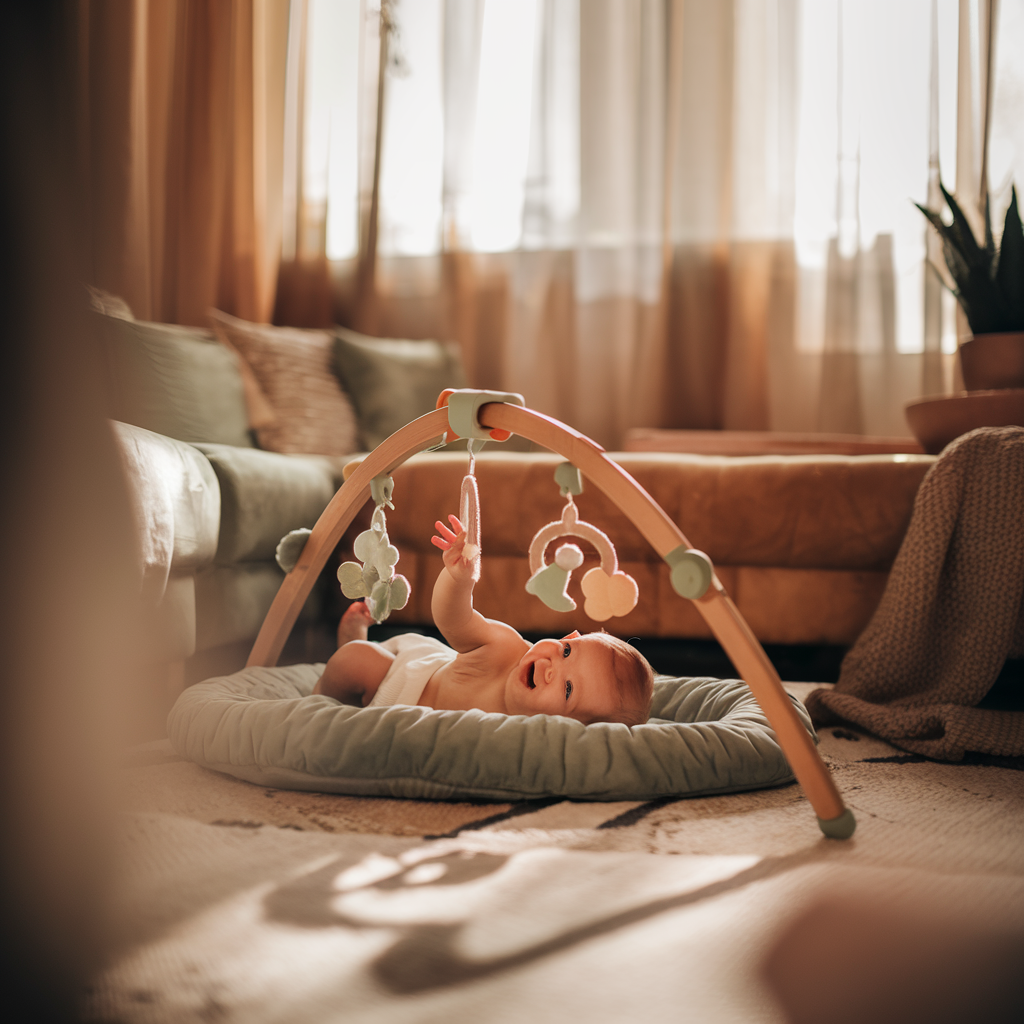
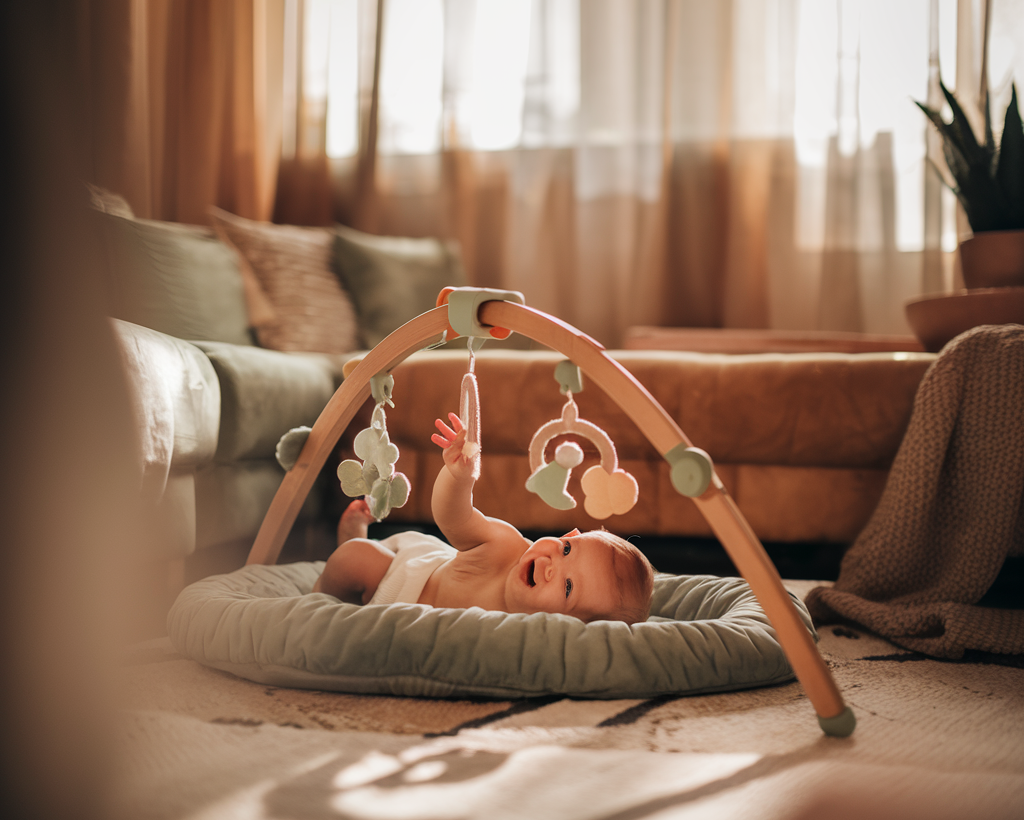
Activity gyms and play mats are used heavily from approximately 8 weeks — when babies can focus on objects and begin batting — through to around 6 months when mobility develops. A good one supports tummy time, visual development, and early sensory exploration.
What makes an activity gym developmentally useful
Arch height and span — low arches prevent reaching practice; high arches allow batting from supine position. Tummy time support — a slight wedge position increases tummy time tolerance in young babies. Toy variety — high contrast patterns for newborns (before full colour vision at ~4 months); varied textures and sounds for developing babies. Washability — a mat that can be washed is essential.
Budget: Fisher-Price Deluxe Kick and Play Piano Gym — ~£45
A piano at the foot plays music and lights when baby kicks it — providing immediate reinforcement for foot movement that most babies find extremely engaging from around 8 weeks. Multiple hanging toys on the arch. Folds flat for storage. The music and lights engage from earlier than many competitors, effective before full colour vision develops.
Pros: Piano provides immediate feedback, engages from early age, folds flat, good value
Cons: Music can be irritating to adults at volume, less cushioned mat than premium alternatives
Best for: Most families — reliable engagement from 8 weeks with features that grow with the baby
Mid-range: Infantino Twist & Fold Activity Gym — ~£40
Folds into a stand-up play yard for older babies, extending useful life. Well-padded mat, adjustable arches, hanging toys include textures, mirrors, and rattles. Includes a tummy time wedge pillow — one of the most underrated features in an activity gym given how much supervised tummy time is recommended.
Pros: Tummy time wedge included, converts to play yard, well-padded mat, adjustable arches
Cons: Play yard conversion less useful than it sounds, slightly bulkier when folded
Best for: Families who want tummy time support included and a mat that transitions to later stages
Premium: Lovevery Play Gym — ~£130
Designed by child development specialists with specific developmental goals for each stage: high-contrast black and white for newborns; batting toys for 2–4 months; puppet and activity cards later. Organic cotton, machine washable, non-toxic. Genuinely covers every developmental stage of the 0–12 month period more thoughtfully than any competitor.
Pros: Developmental stage design, organic cotton, machine washable, includes developmental card activities
Cons: £130 significant; some features replicable with cheaper products
Best for: Parents who want the most developmentally-informed option, or who will use it for multiple children
How to choose for your baby’s age
The primary developmental function of a play mat in the first 3 months is supervised tummy time, not entertainment. A firm, flat surface is essential — soft padded mats feel comfortable but impede the neck and core work that makes tummy time developmentally valuable. Start tummy time from birth: 2–3 minutes 3–4 times daily, building to 30+ minutes daily by 3 months. The American Academy of Pediatrics and NHS both recommend tummy time as the primary early infant physical development activity.
Frequently Asked Questions
When should I start using an activity gym?
From birth for tummy time and high-contrast visual stimulation. From approximately 6–8 weeks for supervised batting at hanging toys.
How long will we use an activity gym?
Most activity gyms are used intensively from 8 weeks to approximately 5–6 months, when babies become mobile and more interested in exploring their environment.
What are the developmental benefits of an activity gym?
From 8 weeks: high-contrast patterns stimulate visual development before full colour vision. Hanging objects at appropriate distance (approximately 25–30cm) encourage focusing and early eye-hand coordination. From 3–4 months: batting and reaching develop voluntary arm control and spatial awareness. Textures and sounds provide multisensory exploration. Mirror panels support early self-recognition development. Kicking a piano (Fisher-Price gym) provides immediate cause-and-effect feedback that babies find deeply engaging from 8 weeks.
Related Reading
- 1 month old baby: milestones, sleep & feeding guide
- Tummy time: how to do it, when to start and why it matters
Disclosure: This post contains affiliate links. If you buy through our links we may earn a small commission at no extra cost to you. We research products independently and are never paid to recommend specific items.
Found this helpful? Sign up to the LylyMama newsletter for honest, researched guides on everything you need in pregnancy and early parenthood.
The piano’s immediate auditory and visual response to foot movement is what makes this gym exceptional from 8 weeks — cause-and-effect feedback is one of the earliest and most important cognitive developments. The large playmat surface accommodates supervised rolling from approximately 4 months. Detachable piano works as a standalone toy. Folds flat with the arch folded down.
The tummy time wedge pillow changes the angle of tummy time, reducing the effort required and making it more tolerable for babies who resist flat-surface tummy time. The arch toys are removable for floor play or tummy time use separately. Converting to a play yard (removing the arch and adding the border panels) extends the product’s life as mobility develops.
The Lovevery’s high-contrast black-and-white card set — included and designed by child development specialists — is the most useful feature for newborns before full colour vision develops at approximately 4 months. The organic cotton mat is the most substantial surface in the category. The mirror panel and various textures address different developmental windows. Multiple children offset the cost significantly.