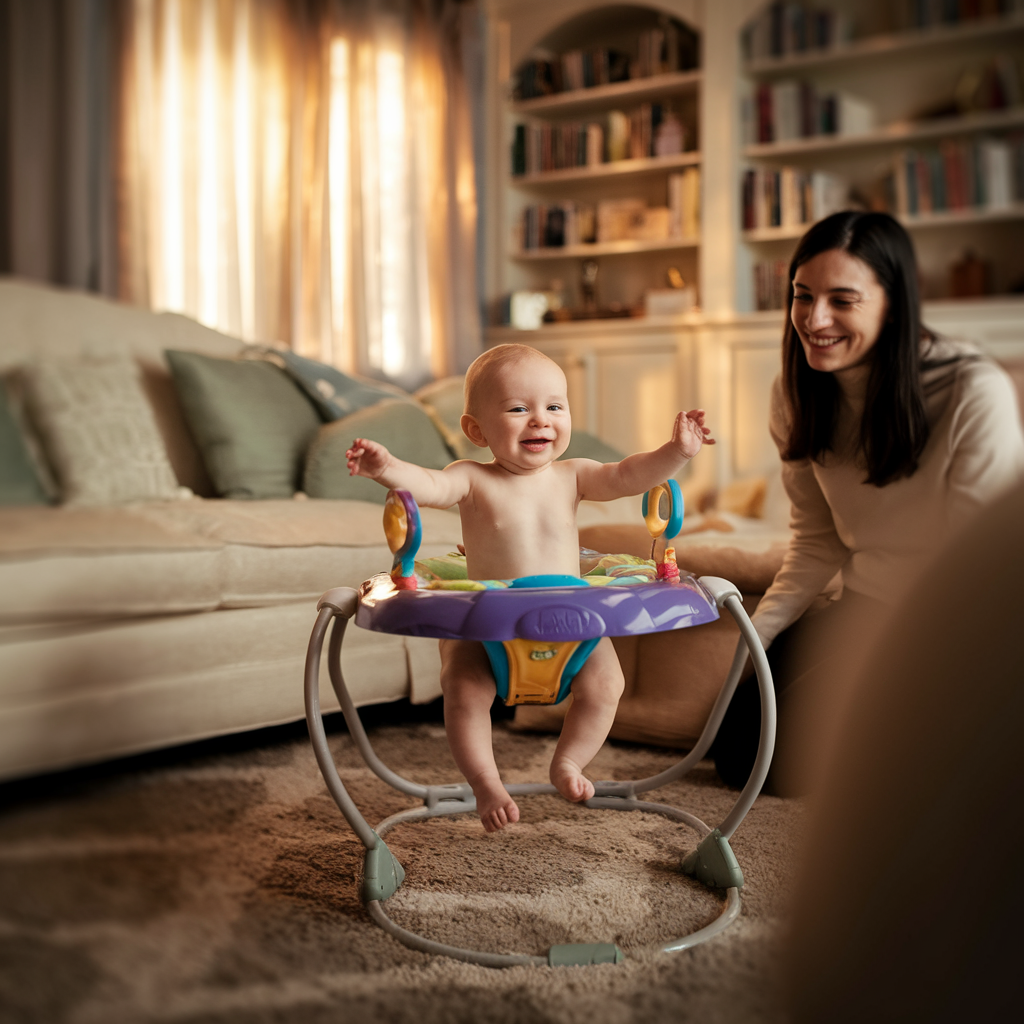
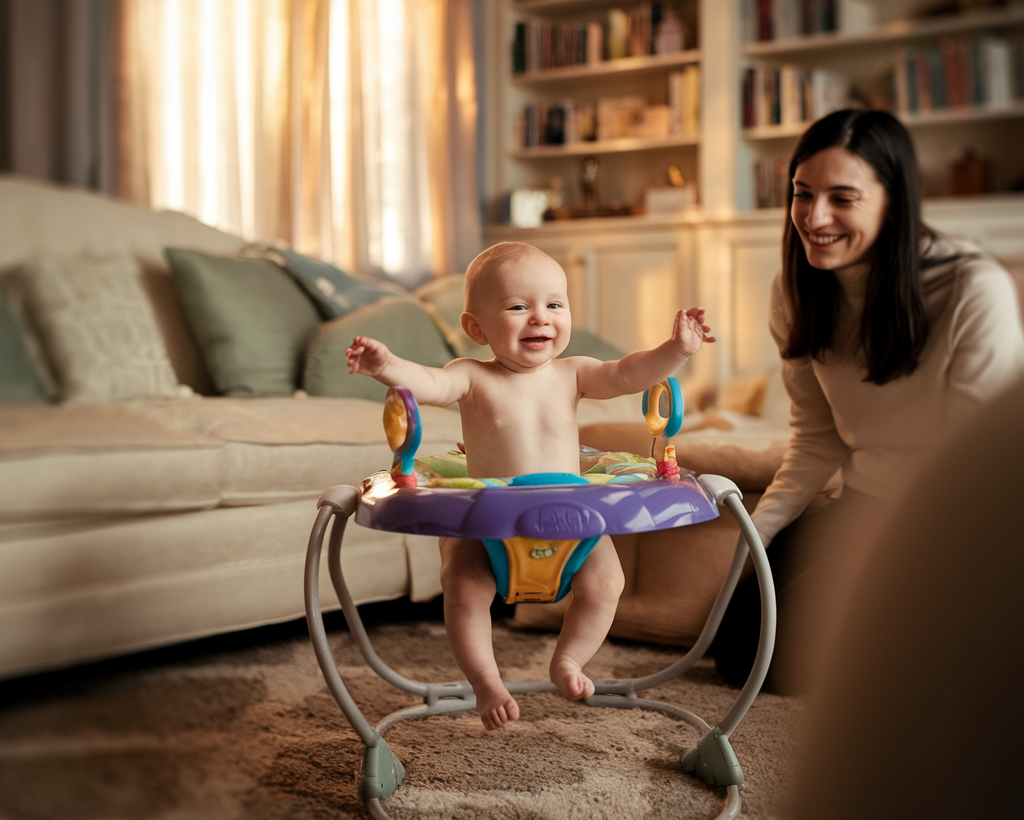
Quick answer: From approximately 4–6 months, when a baby can hold their head steady without support and shows the ability to partially bear weight on their legs when held standing. Jumperoos and exersaucers should be used for short periods only — 15–20 minutes maximum per session — and are not substitutes for floor time.
The developmental requirements
A jumperoo or exersaucer requires: adequate head control (the head must not bob or flop — full steady head control, typically established by 4 months); sufficient core strength to maintain a partially upright position; and some leg weight-bearing ability. The minimum weight recommendations on most products (typically 5–7kg) exist for the same reason. Most manufacturers also state a maximum sitting height (often 30–32 inches / 76–81cm) for correct foot placement — the baby’s feet should touch the floor flat, not on tiptoes.
Benefits: engagement and physical stimulation
Jumperoos and exersaucers provide three developmental benefits when used appropriately: vestibular stimulation (the bouncing and motion develop the inner ear balance system); visual engagement (the toys and activity panels at eye level provide cognitive stimulation); and the social experience of upright interaction with the environment. The physical element — bouncing and leg movement — also builds leg strength in the context of bearing weight, which contributes to preparation for standing.
The risks of overuse
The main concern about jumperoos and exersaucers is overuse. Extended time in these devices (more than 15–20 minutes per session, multiple sessions daily) contributes to: reduced floor time (tummy time and floor exploration are developmentally superior to time in a device); potential impact on hip positioning (the ‘M-position’ of normal hip development is not maintained in all exersaucer designs); and increased time in a position that doesn’t develop core muscles as effectively as floor play. Some paediatric physiotherapists have noted that babies who spend large amounts of time in jumperoos can develop tip-toe walking patterns — the ankle plantar flexion reinforced by the bouncing motion. This is generally mild and temporary when use is appropriate.
Baby walkers: the exception
Baby walkers (the rolling wheeled devices that allow a baby to ‘walk’ before they can walk independently) are a different category — they are not recommended at all. Baby walkers are associated with delayed independent walking, delayed crawling, delayed cognitive development related to motor exploration, and are the most common cause of serious injury in infancy (falls down stairs, reaching hazards the baby couldn’t reach independently). They are banned in Canada. The NHS advises against them. Jumperoos and exersaucers (stationary bouncers) are different products and do not share these specific risks.
Frequently Asked Questions
How long can my baby be in a jumperoo each day?
15–20 minutes per session, 1–2 sessions per day maximum is the general guidance. The majority of wakeful time should be floor time — on their tummy, on their back, and freely exploring. Devices should supplement, not replace, free floor play.
Can a jumperoo help my baby walk?
The evidence doesn’t support jumperoos specifically accelerating walking. What accelerates walking is floor time, supported standing, cruising (holding furniture), and the natural developmental progression. A jumperoo provides some leg muscle engagement but doesn’t substitute for the full-body coordination development of floor exploration.
My baby loves the jumperoo and cries when I take them out — is it okay to extend the time?
Not consistently. The baby’s enjoyment is not the primary guide here — many babies also enjoy being held constantly, eating only puréed fruit, and staying up until midnight. Short, enjoyable sessions protect the developmental benefits while limiting the downside of overuse.
Related Reading
- 1 month old baby: milestones, sleep & feeding guide
- 4 month old baby: rolling, grabbing & the 4-month sleep regression
- 5 month old baby: ready for solid foods? Signs to look for
- Sensory play ideas: activities for babies 0-12 months by age
Found this helpful? Sign up to the LylyMama newsletter — evidence-based answers to the questions every new parent actually has.