
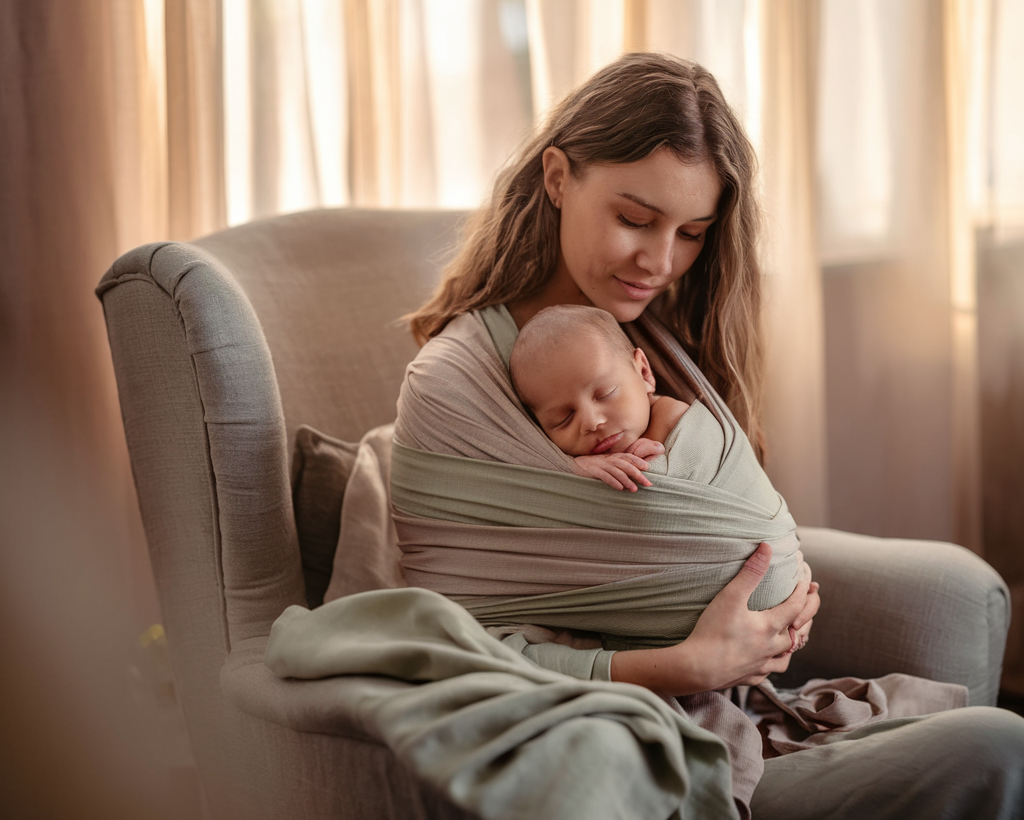
Carrying your baby in a carrier or sling has strong evidence behind it: reduced crying, improved breastfeeding rates, easier settling, and benefits for parental wellbeing. The type of carrier affects comfort, ease of use, and age suitability.
What makes babywearing safe and effective
Safety first — T.I.C.K.S. rules: Tight, In view, Close enough to kiss, Keep chin off chest, Supported back. Any carrier must meet these. Weight distribution — waist belt carriers (SSCs) distribute weight through the hips; shoulder-only carriers concentrate load on shoulders. Ease of use — ring slings have a learning curve; SSCs are more intuitive.
Budget: Close Caboo Lite Stretchy Wrap — ~£40
A pre-tied stretchy wrap — the most common barrier to stretchy wrap use (tying from scratch) is eliminated because it’s structured like a ring sling but stretches like a wrap. Suitable from 3.2kg to approximately 13kg. Naturally holds newborns in the M-position. Lightweight, machine washable, good for newborns without the tying complexity.
Pros: Pre-tied, safe M-position for hips, lightweight, machine washable
Cons: Less weight-bearing for older babies, can feel hot in summer, limited to ~13kg
Best for: Newborn through early months, first-time babywearing, parents who want simplicity
Mid-range: Ergobaby Omni 360 — ~£160
Works from birth (no insert required) in four carry positions: front inward, front outward, hip, and back carry. The waistbelt system distributes weight effectively for carries from 30 minutes to 3+ hours. At 16kg maximum it carries most children to 3 years. One of the most consistently recommended SSCs across babywearing consultant recommendations.
Pros: No insert needed from birth, four carry positions, good weight distribution, high maximum weight
Cons: Higher price, bulkier when packed, front outward position divides expert opinion
Best for: Families wanting an all-in-one SSC from birth to toddler with maximum versatility
Premium: Tula Free-to-Grow Carrier — ~£120
Widely considered one of the most comfortable SSCs for both parent and baby. Adjusts to fit newborns through toddlers without a separate insert. The wide waistbelt provides excellent hip support for extended carries. Beautiful fabric options. For parents who carry regularly, the ergonomic quality makes a tangible difference.
Pros: Excellent ergonomics, grows with baby without inserts, beautiful fabric options
Cons: Similar price to Ergobaby but fewer carry positions
Best for: Regular carriers who prioritise ergonomic comfort for extended carries
How to find the right carrier for you
Before buying: visit a sling library (slingpages.co.uk lists all UK libraries). A sling consultant will assess your body shape, your baby’s stage, and demonstrate different carrier types before you spend any money. Libraries charge £0–10 per session and allow borrowing. This costs less than buying one wrong carrier. For parents who will carry regularly and for extended periods: weight distribution through a waistbelt matters enormously by the second hour; test a waistbelt carrier before dismissing it as unnecessary.
Frequently Asked Questions
Can I babywear from birth?
Yes — with the right carrier and technique. Maintain T.I.C.K.S. rules and check positioning every 5–10 minutes in early weeks. UK sling libraries allow trying before buying — invaluable given the range and investment.
What is the hip-healthy position?
M-position: baby’s knees higher than bottom, thighs fully supported from knee to knee, knees bent out to sides in frog-leg position.
Can I back carry my baby?
Back carrying in a soft structured carrier or woven wrap is appropriate from when the baby has strong independent head control — typically 4–6 months, confirmed by your sling librarian. Back carrying distributes the baby’s weight across both carrier and parent more evenly for extended carries. Follow the carrier manufacturer’s minimum age/weight guidance and get a back carry assessed by a trained sling consultant for the first time.
Related Reading
- Babywearing guide: carriers, safety and benefits
- Hip dysplasia in babies: what DDH means and how it’s treated
Disclosure: This post contains affiliate links. If you buy through our links we may earn a small commission at no extra cost to you. We research products independently and are never paid to recommend specific items.
Found this helpful? Sign up to the LylyMama newsletter for honest, researched guides on everything you need in pregnancy and early parenthood.
The Caboo Lite’s pre-tied design means you put it on once and simply slip the baby in and out throughout the day — no retying between uses. The crossed wrap sections create the M-position naturally. Machine washable. For parents who were deterred from wrap carrying by the tying complexity, the Caboo is the accessible entry point.
The Omni 360 Cool Air’s SoftFlex mesh is the version to choose if you live somewhere warm or plan to carry in summer — the temperature difference with regular fabric carriers is meaningful on a hot day. The internal seat button adjusting from newborn to toddler is genuine and reliable: no separate insert to lose, no additional purchase. Front inward, front outward, hip, and back carry covered.
The Tula’s wide padded waistbelt is its distinguishing ergonomic feature — it wraps fully around the hip bones and distributes load across a significantly larger surface area than narrow waistbelts. For parents who carry for extended periods (2+ hours), this difference becomes tangible. The bamboo fabric options are notably softer than standard canvas.