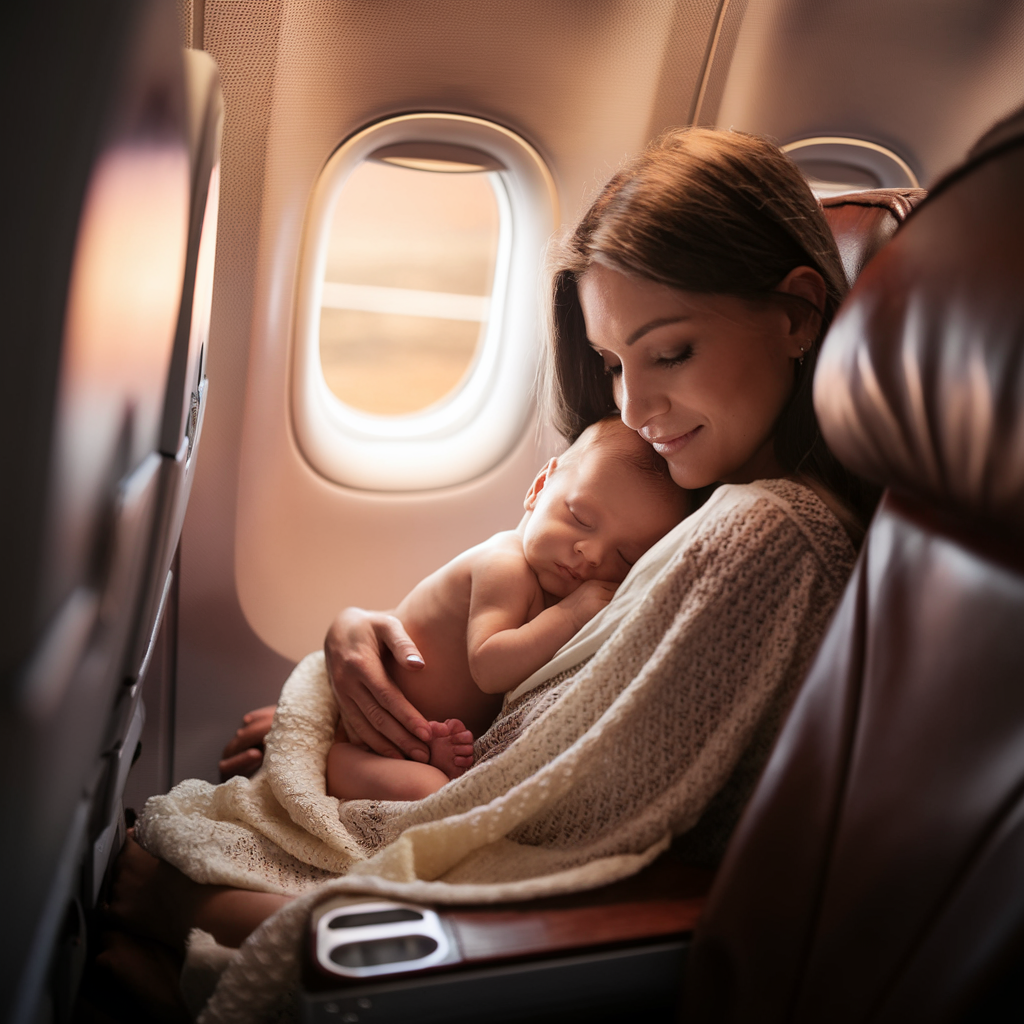
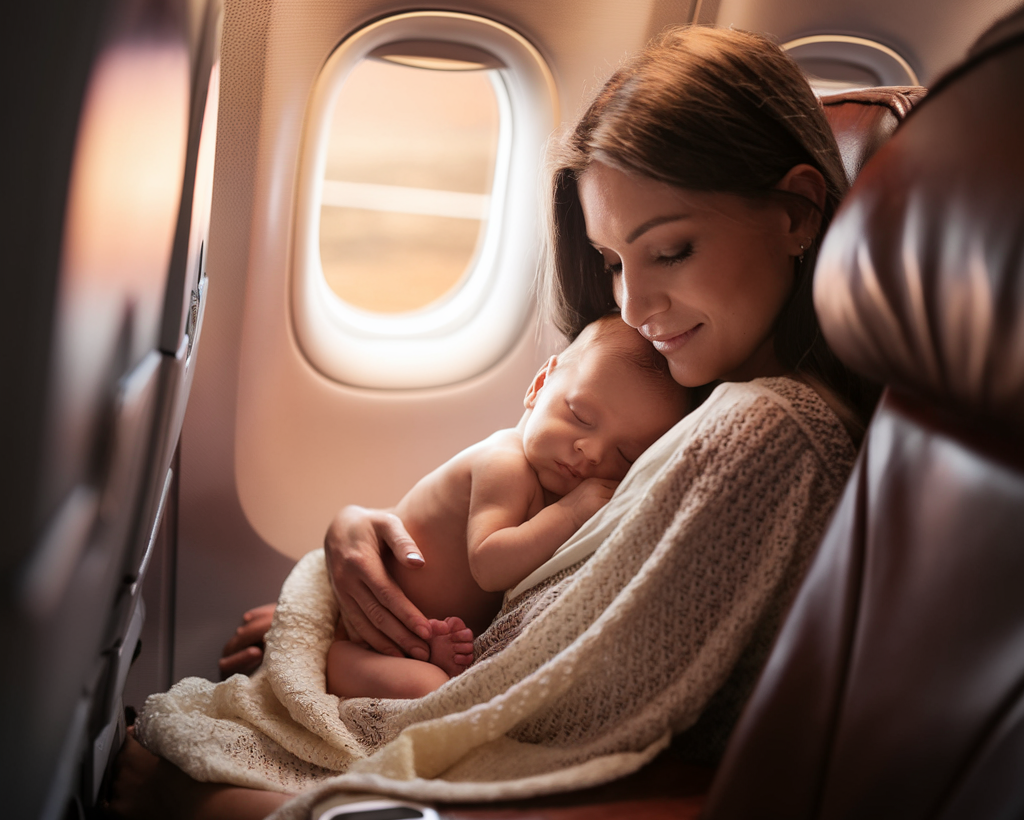
Quick answer: Yes — flying is safe for healthy full-term babies. Most airlines accept infants from 7–14 days old. The main practical challenges are ear pressure, sleep disruption, and managing feeds and diapers in a confined space — not safety concerns.
Age and timing considerations
Most airlines set a minimum age of 7–14 days for lap infants; some require a doctor’s letter for babies under 2–4 weeks. Paediatric advice generally suggests waiting until at least 4–6 weeks for longer flights to allow the immune system some development, though there is no strict medical prohibition for healthy full-term babies before this. Premature babies (born before 37 weeks) should be assessed by their pediatrician before flying — their lungs may be more sensitive to the reduced cabin oxygen levels (typically equivalent to an altitude of 6,000–8,000 feet). Very young babies with any ongoing respiratory or cardiovascular conditions need medical clearance.
Ear pressure: the main discomfort
Cabin pressure changes during ascent and descent can cause ear discomfort in young babies because their Eustachian tubes are narrow and don’t equalise pressure as efficiently as adults’. The solution: feed or offer a pacifier/pacifier during take-off and landing. Swallowing and sucking help equalise the pressure. Babies who are awake and actively feeding during these phases typically cope much better than those who are asleep and then wake to the discomfort. Time your feed so the baby is hungry at take-off.
Seat vs lap infant
Under 2, most airlines allow an infant to travel as a ‘lap infant’ for free or a small fee internationally. Aviation safety experts and the FAA recommend that children under 40 pounds travel in an FAA-approved child restraint system in their own seat — an unsecured baby in turbulence is at genuine risk. The practical compromise most families make: lap infant for short or medium-haul flights; own seat with car seat for long-haul or known turbulent routes.
Packing for the flight
Carry diapers for twice as long as the flight duration — delays happen. Wipes, 2 spare babygrows in the carry-on (leaks happen at altitude). If formula feeding: pre-measured portions in a dispenser, bottled water (airport security rules on formula liquid vary — prepared formula in a bottle for the feed is generally allowed after security checks). Breastfeeding: no equipment needed, easiest feeding method on planes. A baby carrier for boarding and disembarking — allows both hands free through security.
Jet lag and time zone adjustment
For short trips (under 2-hour time difference): keep the baby on home time zone. For longer: shift sleep and feed times by 30 minutes per day in the direction of travel starting 3–4 days before departure. On arrival, bright light at local morning time and darkness at local night time resets the circadian rhythm faster than any other intervention. Young babies (under 3 months) don’t have an established circadian rhythm and are generally more adaptable than older babies who are in a fixed routine.
Frequently Asked Questions
Does flying affect a baby’s ears permanently?
No — ear discomfort from cabin pressure is temporary and does not cause hearing damage or permanent ear problems in healthy babies. Babies with active ear infections should not fly if possible, as the pressure changes can be significantly more painful and may risk ear drum rupture.
Can I take baby formula through airport security?
In the UK and US: formula (powder and liquid), breast milk, and baby food are exempt from the 100ml liquid rule in reasonable quantities for the journey. You may be asked to open containers for checking. Carry documentation of your flight length if bringing large quantities. In EU airports the rules are similar but individual security staff application varies — be prepared to explain.
What’s the best seat on the plane with a baby?
Bulkhead seats (first row of a cabin section) often have bassinet rails on long-haul flights — book early as these are limited and go to the first families who book. Aisle seats allow faster access to diaper change facilities without disturbing other passengers. Avoid exit rows (car seats not permitted, specific rules about travelling with infants).
Related Reading
- Travel with baby checklist: don’t forget a thing
- 3 month old baby: sleep regression or just a growth spurt?
- Best baby carriers: wraps, ring slings and structured SSCs
Found this helpful? Sign up to the LylyMama newsletter — evidence-based answers to the questions every new parent actually has.