
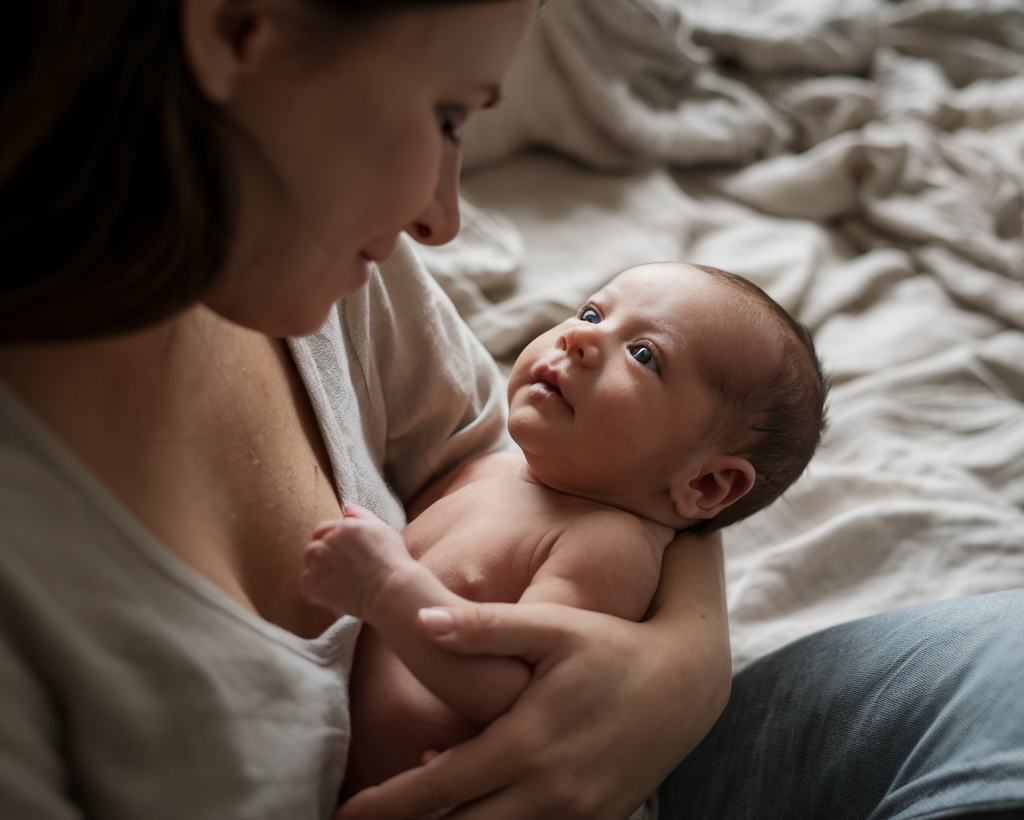
Quick answer: Your newborn arrives in the world already equipped with functional senses — though each is at a different stage of development.
Your newborn arrives in the world already equipped with functional senses — though each is at a different stage of development. Understanding what your baby can and cannot perceive helps you interact more meaningfully and set appropriate expectations for their development.
What Baby Can Smell
The sense of smell is the most developed of all senses at birth — and possibly the most important for bonding. Studies show newborns prefer the smell of their own mother’s amniotic fluid (which is continuous with breastmilk aroma) over any other smell. Within hours of birth, a breastfed newborn can distinguish their mother’s breast pad from another mother’s. The olfactory system (smell) is one of the oldest evolutionary systems in the brain and connects directly to the limbic system (emotion and memory) without going through the thalamus — which is why scent-memory is so immediate and powerful. Practical implications: your natural scent is deeply calming for your baby. Unwashed t-shirts left near the sleep area when you’re absent can reduce crying. Heavy perfumes or scented products can interfere with the olfactory bond and are worth minimizing.
What Baby Can Hear
Hearing is functional from approximately week 18 of pregnancy — newborns arrive with a well-developed auditory system that has been processing sounds for 5 months. At birth, newborns can: recognize their mother’s voice (shown to prefer it to a stranger’s voice), recognize familiar voices or sounds heard regularly in utero, respond to loud sounds with the Moro startle reflex, and prefer higher-pitched voices (motherese — the instinctive higher-pitched speech adults use with babies is not accidental; it’s neurologically more salient to a newborn’s auditory system). Newborn hearing range is normal at birth (though some have temporary fluid in the ear canal affecting the first hearing screen — this is why a failed initial screen triggers a retest rather than immediate concern).
What Baby Can See
Vision is the least developed sense at birth. The newborn visual system can: focus at approximately 8–12 inches (20–30cm) — the distance from breast to face during feeding, and the most naturally occurring face-viewing distance. See high contrast (black and white or strong color contrasts) more clearly than subtle colors. Track a slowly moving object within their focus range. Recognize their mother’s face by approximately 2–3 days (shown in studies using preference paradigms). What they cannot do well: Focus at distances beyond 12 inches, distinguish colors in the first months (full color vision develops by 3–4 months), and track fast-moving objects. Vision develops rapidly — by 3 months, focus range extends to several feet; by 6 months, vision approaches adult capability.
What Baby Can Feel
Touch is the most immediate and powerful communication channel with your newborn. The skin contains the highest density of sensory receptors of any organ, and touch activates complex neurological pathways affecting stress regulation, pain, and bonding. Newborns feel: temperature (they will startle and cry when placed on cold surfaces), pain (neonatal pain is real and affects brain development — this is why analgesia during procedures matters), pressure and containment (which activates calming reflexes), gentle movement and rocking, and their own mouth, hands, and face most acutely (these areas have the highest sensory density). Kangaroo care (skin-to-skin contact) works partly through the touch pathway — the steady, warm, rhythmic pressure of a caregiver’s body is neurologically distinct from mechanical contact.
What Baby Can Taste
Taste receptors are functional before birth — amniotic fluid is flavored by whatever the mother eats, and studies show newborns prefer sweet tastes (colostrum and breast milk are mildly sweet) and reject bitter and sour tastes. Newborns prefer: sweet (universal among mammals — associated with safe, caloric food). Newborns reject: bitter (associated with toxins in evolutionary terms). Interestingly, exposure to flavors through amniotic fluid and breast milk shapes flavor preferences — breastfed babies whose mothers ate a varied diet are often more accepting of varied foods at weaning.
Frequently Asked Questions
Can my newborn recognize me?
Yes — within days of birth, your newborn can recognize you by smell (immediately) and voice (immediately, from antenatal exposure), and by sight (by 2–3 days). Their recognition system prioritizes smell and sound before vision because these systems are more mature at birth. By 6–8 weeks, they will smile specifically at your face — one of the most rewarding developmental milestones of early parenthood.
How should I stimulate my newborn’s senses?
Normal caregiving provides ideal sensory stimulation: your face at feeding distance (vision), your voice during feeding and care (auditory), skin-to-skin contact (touch), your natural scent (smell). High-contrast black and white images can be interesting for newborns aged 2–6 weeks. Simple, slow tracking games with a high-contrast object within 12 inches. Don’t overstimulate — newborns have limited capacity for sensory input before they reach overwhelm threshold. Signs of overstimulation: gaze aversion, arching away, hiccups, sneezing, yawning.
When should I be concerned about my baby’s development?
At the newborn stage, concerns warranting evaluation: failed newborn hearing screen at follow-up, eyes that consistently cross or don’t track at all by 3 months, no response to sudden loud sounds, and no social smile by 8 weeks (discuss with your pediatrician, though some babies smile later without concern). Your pediatrician will screen developmental milestones at each well-baby visit.
Related Reading
Found this helpful? Sign up to the LylyMama newsletter for more honest, evidence-based parenting guides delivered to your inbox every week.